
TMNCPC Event Calendar
Monthly Program: Texas Through Deep Time
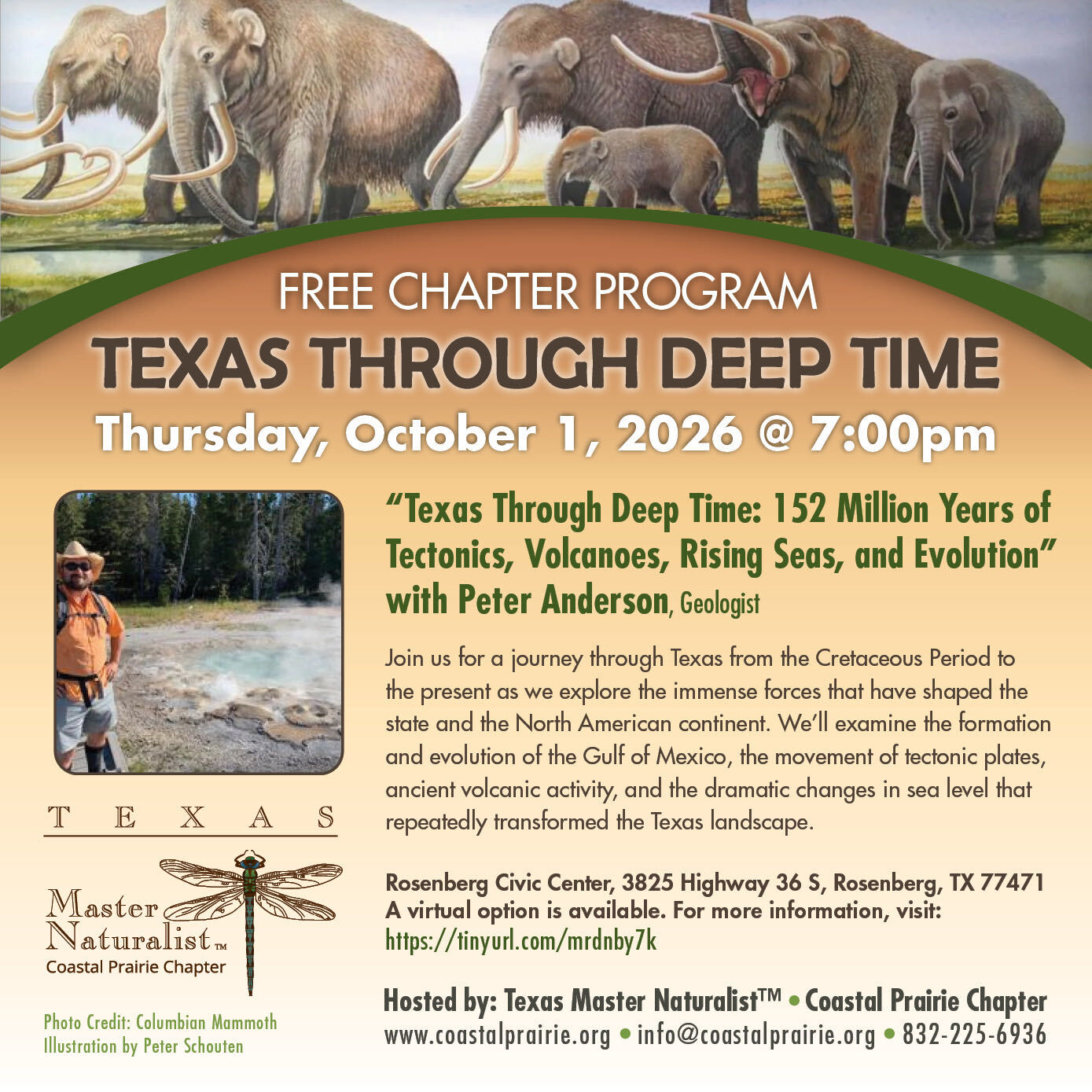
What did Texas look like 152 million years ago? The answer is far stranger—and more fascinating—than you might expect.
Join geologist Peter Anderson for a journey through Texas from the Cretaceous Period to the present as we explore the immense forces that have shaped the state and the North American continent. We will examine the formation and evolution of the Gulf of Mexico, the movement of tectonic plates, ancient volcanic activity, and the dramatic changes in sea level that repeatedly transformed the Texas landscape.
As we travel through deep time, we will follow evidence preserved in the rocks and fossils of the Gulf Coast, Hill Country, and West Texas mountains. We will discover how the interactions between oceans and continents created recurring cycles of rising and falling seas—and left behind a remarkable record of Texas’s changing environments and evolving life.
Along the way, we will explore some of the region’s most intriguing fossils, from long-extinct species to organisms with living relatives today, and we will consider some of the geological mysteries that scientists still can’t fully explain.
Come discover how the Texas we know today was shaped by 152 million years of moving continents, erupting volcanoes, changing seas, and evolution.
Peter Anderson is the Geology Department Head at Wharton County Junior College. He earned his B.S. from West Virginia University and later moved to Texas to pursue an M.S. in Micropaleontology and Stratigraphy at the University of Texas at San Antonio.
After working for several years in the oil and gas and geotechnical industries, Peter returned to academia to pursue a Ph.D. at the University of Houston, where his research focused on Cretaceous magmatism and the early development of the Gulf of Mexico. He ultimately stepped away from his doctoral studies to pursue his passion for teaching at the community college level, where he continues to inspire students today.
In recent years, Peter has partnered with the University of Houston through a National Science Foundation-funded program that gives his students the opportunity to conduct fieldwork, geological experiments, and specimen collections early in their academic careers. Through these experiences, he brings geology to life both inside and outside the classroom.
Coastal Prairie Chapter programs are free and open to the public. This program will be held in-person at the Rosenberg Civic Center, 3825 TX-36, Rosenberg, TX 77471 Please plan to arrive at 6:00 pm for refreshments and social time. The program starts at 7pm.
Click here for Zoom registration link
To log hours in VMS:
Log Chapter Program under AT: Chapter Program
Log the following Business Meeting under Chapter Business: Chapter Meeting